Queer Healing: Exploring Dramaturgies of Suspension in Queer Contemporary Performance
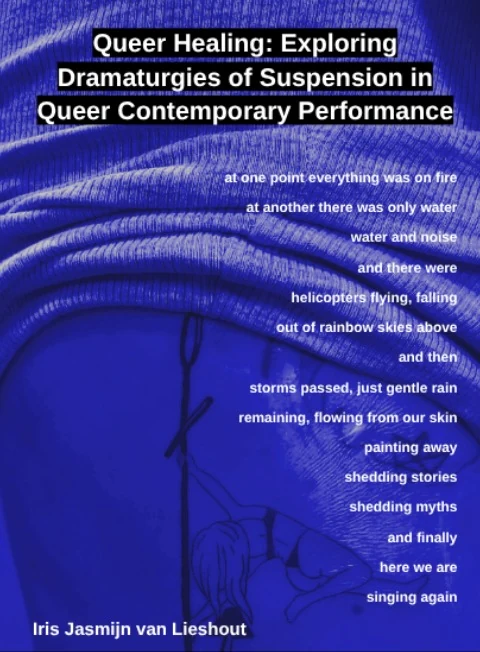
In my master’s thesis I examine how queer contemporary performance can bring about healing, taking Florentina Holzinger’s Ophelia’s Got Talent (2022) as a starting point. Holzinger reinterprets Shakespeare’s Ophelia as a symbol of empowerment: her drowning becomes an act of agency. An all-female cast reclaims trauma through daredevilry, within the format of a talent show.
Water runs through the whole performance: a swimming pool that turns from clear blue to murky and red, a water tank, sirens, nymphs and mermaids. Using Astrida Neimanis’ “hydrologics” (in particular unknowability, the capacity of water to escape full human understanding and control), I show how the performance presents water as everything and as nothing fixed at the same time. This makes for a porous spectatorship: like someone floating in water, the spectator feels weightless and vulnerable at once, open to body, senses and the bodies of others. Together with Victor Turner’s betwixt and between, the performance holds the spectator in a state of suspension.
Water is also historically bound up with femininity and passivity. Drawing on Cara Berger’s hydro-dramaturgy, I show how the performance both evokes and undermines these associations. With José Esteban Muñoz’ concept of disidentification I analyse how the performers distance themselves from the passive role of the victim (tied above all to white femininity), for instance when Ophelia’s fall is played again and again, screaming and splashing instead of floating serenely.
From this analysis I derive four dramaturgical strategies, which follow the movements of water:
- Ebbing
- slowing down and pulling back, which makes room for reflection and hidden details.
- Flooding
- overwhelming the senses, which brings on disorientation and vulnerability.
- Dissolving
- theatrical frames falling apart, like the talent show format after an act fails.
- Crystallizing
- new forms, relations and possibilities emerging from that dissolution.
I apply these strategies comparatively to three other works: FK Alexander’s (I Could Go On Singing) Over The Rainbow (2016), Jacolby Satterwhite’s Pygmalion’s Ugly Season (2022) and Tibau Beirnaert’s F A G G O T S (2023). This shows that the strategies can support very different statements and break open linear, progress-driven dramaturgies. They put fluidity, change and destruction forward as necessary means of transformation, and so offer a framework for thinking about queer healing in the face of violent normativity.